
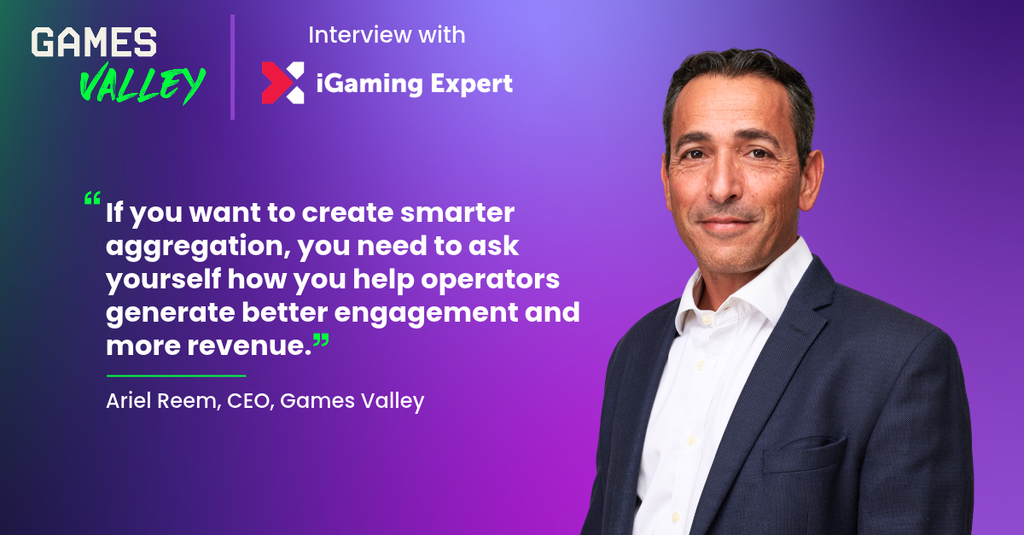
Embarking on a new journey within increasingly trickier waters to navigate would be a daunting prospect to many, but Games Valley is bullish that its growing presence is evidence of a strategy paying off.
Fresh off the back of a maiden stand appearance, with the SBC Summit selected for the honour, CEO Ariel Reem believes that the sky’s the limit for the aggregation platform.
Speaking to iGaming Expert from the showfloor, he delves into various facets of the business; elaborating on why the company is carving a different path to what has come before, and what it has in store when it comes to making statements of intent.
A major theme for Games Valley has been ‘Smarter Aggregation.’ How has that philosophy shaped the way you are building the business, and what does smarter aggregation mean in practice for operators?
To provide games is something that already exists in the industry. If you call yourself a game aggregator that’s what you need to deliver.
But if you want to create smarter integration, you need to ask yourself how you help those operators to generate better engagement and more revenue.
We have developed a layer of intelligence that provides operators with the games that they need to promote in specific markets, but this is also based on different life cycle stages of players.
We know specific games that actually perform better on the first session, which is very, very important to create that engagement.
We also know which games can perform better when it comes to reactivation when a customer comes back. We work very closely with our operators to try to help them to increase their revenue. That is just one example.
Another is with regards to the friction of how you can lose money without actually being aware that the API has a failure in response between the game vendors and the operators.
In most of the cases, surprisingly, it’s not being monitored properly by the operators. Having said that, we created the tools to help the operator know when those problems happen, and we alert them to improve it.
You introduced GameFrame AI as part of your growing technology offering. What problem does the tool solve, and how do you see AI changing the way iGaming marketing teams create and manage campaigns?
To go back again to the example with the thumbnails, if I was an operator and there’s Halloween just around the corner and I want a great promotion around it, I will go to my design team and ask them to start to take some few thumbnails and change them to the Halloween style. This would cost a lot of money and time.
Today, we have an AI platform where you just write down what you want and you get it at the press of a button. That’s part of the thing that we want to create to support our operators.
As simple as that.
OnTrack has also become an important part of the Games Valley proposition. Why did you decide to expand beyond aggregation into marketing analytics, and what are operators telling you they need from their data today?
Initially, the whole conversation to bring OnTrack on board was not because we developed OnTrack. OnTrack already existed before we even thought about it.
It’s a product that we developed over the years that is built on almost two decades of experience with B2C. We understood that there is a painful point when it comes to how you acquire new players.
Eventually, as an affiliate manager, they need to manage multiple deals, and some of them are coming with one or more very complex permutations.
For example, you can have one affiliate delivering traffic to six different brands across 10 different territories. Now go and figure which one is not working properly, which one’s not delivering ROI. That’s become a very complex process.
A company can create the data for that, but then someone needs to sit down and analyse it, and the truth is you don’t have the resources to do it or you don’t have the attention to do it.
That is one example. Another example is that most of the tracking systems out there provide accumulated data of revenue, expenses and so on. You cannot really answer a simple question.
A very basic question is the quality of traffic that you bought from that source three months ago, is the same quality of traffic seven months ago?
You simply cannot get to that answer because that’s cohort ROI, and for that you need to take the data from the tracking system and manipulate it in a very complex way to get to that point.
That’s what OnTrack did. We actually integrated those leading tracking systems out there, and we can do that. The operator doesn’t need to do anything. We provide a weekly meeting that provides an exact action based on what to do.
It’s a premium product. It’s not just a SaaS platform, and that’s why we are so excited about it.
Games Valley has recently signed a deal with Zeal, marking its entry into the German market. What does the German market mean for the company, and what other markets are you looking to enter or strengthen through the end of 2026 and into 2027?
We’ve been looking in the German market for some time. It’s a very interesting market, but it’s more complex when it comes to regulation.
The restriction on games, bet and payouts is totally different from any other market, and we always said to ourselves that we need to find the right partner to go there into the market.
We’ve been looking for the right partner to go to the market in terms of the right skills, good understanding of the market, and what they need.
I’m very happy to say that we found the right one in Zeal that we’re going to go with. We’ll provide the games that they need for the market, and are looking to the point at how we can scale up, improve, and help improve performance.
Our back office is really second to none when it comes to how operators can use and support the day-to-day.
There’s many things that usually can be done manually or require a lot of time. It’s much more accessible for the operator. That’s something that we’re looking at very carefully and are very excited about.
Games Valley made its first major stand appearance at SBC Summit Lisbon this year. What did you want to achieve at the event, and what did you want the industry and potential clients to understand about Games Valley?
It’s the first time we first showcase our brand with a stand, which is important. We have gathered clients over the years, but it’s reached a point that we prefer to have a proper place to meet them.
It’s very important as we’ve come to the point that we can actually showcase some very unique products that we created that are all tailored to the operator side.
Our client is not the player, it’s the operator. We need to support the operator to generate better engagement and drive revenue and all of those things.
At this conference, we are showcasing several products that we created. The top one I would say is the already mentioned in-house thumbnails tool GameFrame AI. This is AI that basically helps operators create quick thumbnails without the use of a design team, or all the time and effort that is involved with that.
Looking ahead to 2027, what is the next chapter for Games Valley? What are the biggest priorities for the business, and where do you see the greatest opportunities for growth?
We’ve been active in Latin America for the past year and a half, and we’ve become increasingly focused on the region. We’ll continue to build on that momentum. We’ve strengthened our team with people who specialise in these markets, and we’re bringing the right localised content to meet their needs.
Looking ahead to 2027, I believe Africa could be our next major focus. We already operate across Europe and have a presence in Asia, so Africa is a very interesting market for our next stage of expansion.
For operators, driving engagement and revenue starts with understanding their players and creating the right experience for them. That means personalised communication, relevant content and, crucially, data that helps operators understand what works.
At Games Valley, our goal is to make this intelligence layer accessible to operators — something that can be very difficult and resource-intensive for them to develop on their own.
In 2027, I expect us to put even greater emphasis on this intelligence layer: providing operators with more insights and knowledge to help them drive engagement and revenue, while developing more AI-powered tools to support those decisions.
Those are the key areas where I see Games Valley focusing its efforts in the year ahead.